A tyre can lose pressure long before it looks completely flat. That is why knowing how to assess tyre punctures matters, whether you are parked at home, outside work, on a school run or stopped at the roadside. A quick, safe check can tell you whether the tyre may simply need attention or whether you should not drive another metre.
The priority is simple: protect yourself, avoid turning a repairable puncture into a ruined tyre, and get the right help quickly. Do not rely on guesswork or keep driving in the hope that the warning light disappears.
Stop somewhere safe before checking the tyre
If the vehicle pulls to one side, feels heavy through the steering wheel, vibrates unexpectedly, or shows a tyre pressure warning, ease off the accelerator and find a safe place to stop. Avoid harsh braking, sharp steering inputs and high speeds. A deflating tyre can affect handling quickly, particularly on a van, SUV or fully loaded family car.
Park on firm, level ground where possible. Apply the handbrake, switch on your hazard lights if you are roadside, and keep clear of moving traffic. On a motorway or other dangerous road, do not inspect the tyre from the traffic side. Move to a place of safety and arrange professional assistance.
Never put your hands near a tyre that is hot after a long or fast journey. Give it time to cool, especially if it has been driven while underinflated. Heat can damage the internal structure even where the outside looks mostly normal.
How to assess tyre punctures with a visual inspection
Start by looking at the whole tyre, not just the part touching the ground. Turn the steering wheel to expose the front tyres if it is safe to do so, then inspect the tread, shoulders and sidewalls. For rear tyres, you may need to move the vehicle slightly only if the tyre is holding pressure and you can do so safely. If it is clearly flat, do not drive it to get a better view.
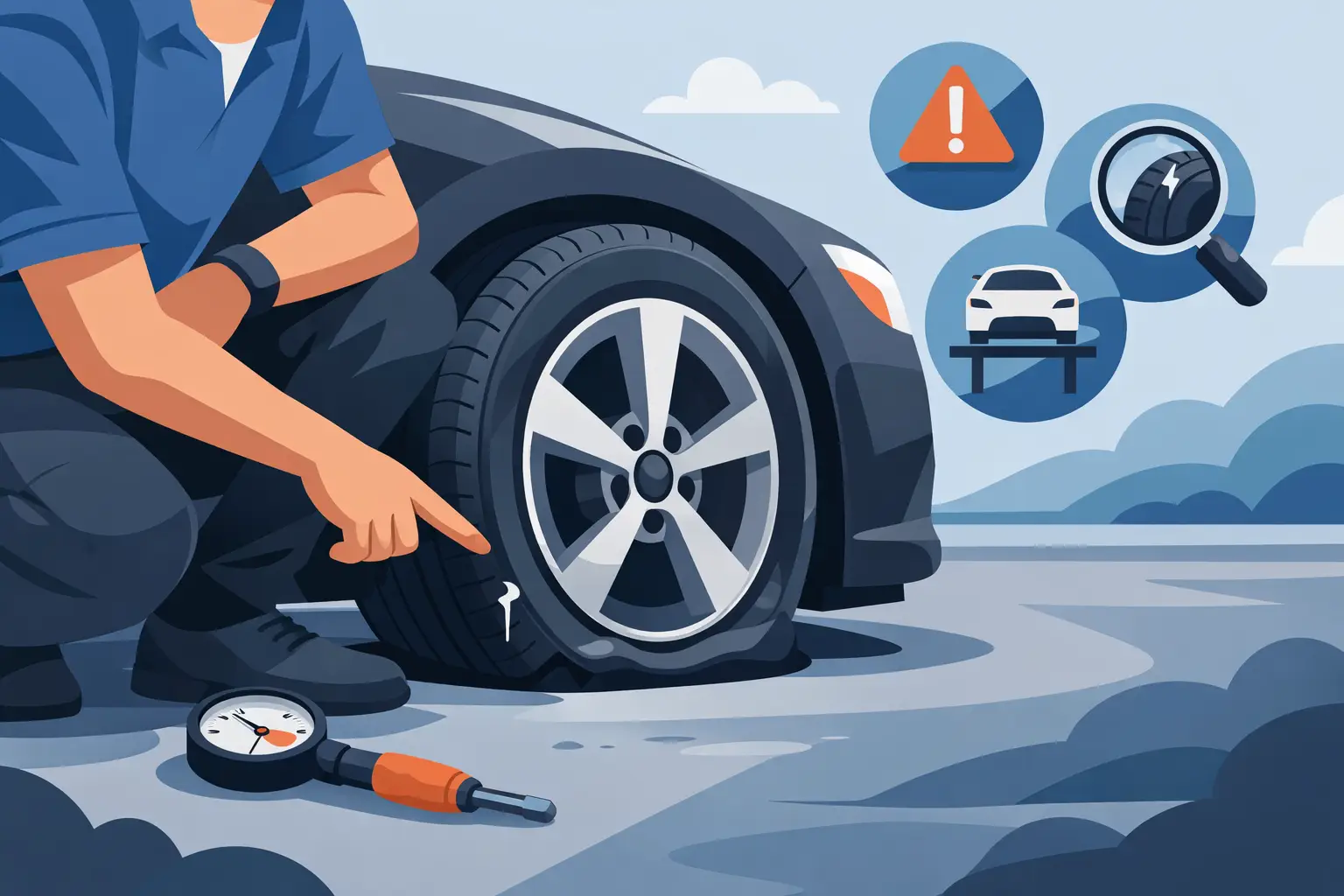
Look for a nail, screw, piece of metal, glass or another object embedded in the tread. A screw is a common cause of a slow puncture, especially after driving through industrial areas, building sites or poorly maintained roads. If you find an object, leave it in place. Pulling it out can allow the remaining air to escape rapidly and make recovery more difficult.
Also check for a cut, split, bulge or tear. Damage to the sidewall or shoulder of a tyre is more serious than a small, central tread puncture. The sidewall flexes constantly as the vehicle moves, so it cannot normally be safely repaired. A bulge may indicate internal cord damage caused by a pothole, kerb strike or impact. Treat this as urgent – the tyre needs replacing.
Pay attention to the tyre bead too, which is the edge where the tyre seals against the wheel rim. Corrosion, a bent alloy wheel, or damage around the rim can cause a slow loss of air without an obvious puncture in the rubber.
Check pressure loss and warning signs
A visibly low tyre needs attention, but not every puncture is obvious. Compare the tyre with the one on the opposite side of the vehicle. If one sits lower, looks more compressed at the bottom or has a noticeably wider contact patch against the road, it may be underinflated.
Use a reliable pressure gauge if you have one. Check the vehicle manufacturer’s recommended pressures, usually found inside the driver’s door frame, fuel flap or handbook. Do not use the maximum pressure printed on the tyre sidewall as your target pressure.
A tyre that has dropped well below its recommended pressure should not be treated as normal just because it can be inflated again. Inflate it only to help establish whether it is losing air, then monitor it closely while stationary. If it falls again within minutes or hours, there is a leak that needs locating.
Tyre pressure monitoring systems are useful, but they are not a full diagnosis. Some systems warn only once the pressure has dropped significantly, and a warning can also follow a temperature change or recently adjusted pressures. Check the tyre itself rather than assuming the sensor is wrong.
Use soapy water to find a slow leak
When there is no visible object or damage, a simple soapy-water test can help identify a leak. Mix a little washing-up liquid with water and apply it carefully around the tread, valve and rim edge. Steady bubbles forming in one spot usually point to escaping air.
Check the valve cap is fitted, then inspect the valve stem for cracks or looseness. A failed valve can mimic a puncture and may be a straightforward fix for a technician. Do not attempt to remove or force the valve core unless you have the correct equipment, as this can release air quickly.
This test is useful for a slow leak at home or work, but it is not a reason to continue driving on a damaged tyre. It will not reveal every internal issue, and it cannot confirm whether a repair is safe.
Decide whether the tyre may be repaired
Not all punctures mean a new tyre. In many cases, a small hole in the central tread area can be professionally repaired if the tyre has not been driven flat and there is no secondary damage. The final decision should be made after the tyre has been removed, inspected internally and assessed against tyre repair standards.
A repair is less likely to be suitable when the damage is in the sidewall or shoulder, the hole is large or irregular, the tread is worn close to the legal minimum, or the tyre has been run at low pressure. In the UK, the minimum legal tread depth is 1.6mm across the central three-quarters of the tyre, around its full circumference. A tyre may still need replacement before reaching that limit if its condition is poor.
Do not use a tyre sealant as a permanent solution. Emergency sealant can sometimes provide enough time to reach safety, depending on the type of puncture and the vehicle, but it may not work on a large hole, sidewall damage or a tyre that has come off the rim. It can also affect the repair process and should be reported to the technician.
When not to drive on a punctured tyre
Do not drive if the tyre is flat, the sidewall is damaged, cords are visible, there is a bulge, the wheel rim is contacting the ground, or the vehicle is difficult to control. The same applies if you have already driven a distance on a deflated tyre. Continuing can destroy the tyre’s internal casing and risk damage to the wheel.
Run-flat tyres are an exception only where the manufacturer’s instructions allow limited travel after pressure loss. Even then, there are strict distance and speed limits. Check the vehicle handbook and arrange an inspection as soon as possible. A run-flat tyre is not permission to carry on with a normal journey.
What to tell a mobile tyre technician
A clear description helps the right tyre, tools and repair equipment arrive with you. Explain your vehicle make, model, tyre size if known, location and whether the tyre is fully flat or slowly losing pressure. Mention any object in the tread, sidewall damage, a locking wheel nut, a warning light or whether sealant has been used.
For drivers across South East London and Kent, Falcon Mobile Tyres Fitting can assess the damage at your home, workplace or roadside and advise whether a safe repair is possible or a replacement is needed. This avoids the risk of driving on a compromised tyre just to reach a garage.
A puncture check is also a safety check
A nail in the tread can look minor, while a tyre that appears untouched may have a leaking valve, rim fault or internal damage. The right response depends on where the damage is, how quickly pressure is falling and whether the tyre has been driven underinflated.
If you are unsure, do not gamble with a busy journey, a loaded van or your family in the car. Leave the object in place, keep the vehicle parked safely and call for professional tyre support. A prompt inspection can be the difference between a straightforward repair and a dangerous roadside failure.