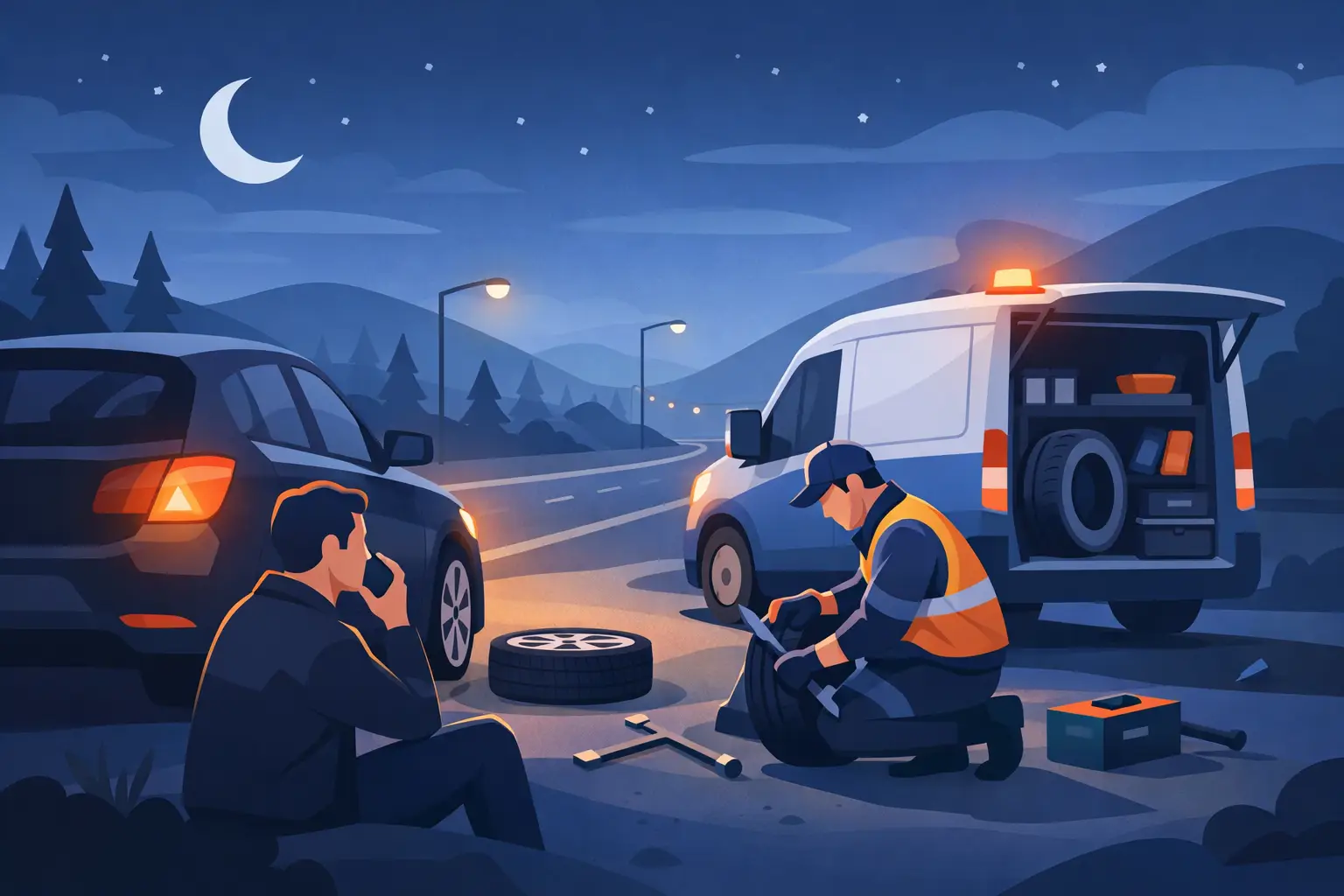
A tyre failure at 1am is not something you can safely put off until morning. Whether you are outside your home, finishing a late shift, parked at work or stopped roadside, this overnight tyre callout guide explains what to do first and how mobile tyre support can get you moving again.
The priority is not getting the job done quickly at any cost. It is getting you, your passengers and your vehicle into a safe position, then arranging the right repair or replacement without a garage visit.
Overnight tyre callout guide: what to do first
As soon as you notice a puncture, blowout or rapidly deflating tyre, reduce speed gently and avoid sharp steering or harsh braking. Find a safe place to stop as soon as possible. If you are already parked, do not drive on a flat tyre to find somewhere more convenient. Doing so can damage the wheel, ruin a tyre that may otherwise be repairable and make the vehicle harder to control.
Switch on your hazard warning lights. If you are on a busy road, keep yourself visible and stay well away from moving traffic. On a motorway, move as far left as you can if the vehicle remains controllable. If you can reach an emergency area or leave at the next exit safely, do so. If you have stopped in an unsafe position, cannot leave the vehicle safely, or are in immediate danger from traffic, contact the emergency services.
Once you are in a safe place, check the tyre only if it is safe to do so. You do not need to diagnose every detail. A screw in the tread, a split sidewall, a damaged valve or a completely flat tyre are all useful observations, but a mobile technician can assess the fault on arrival.
Avoid attempting a roadside wheel change in poor light, heavy rain, narrow roads or fast-moving traffic. The spare wheel may also be underinflated, unsuitable for the vehicle or missing altogether. A temporary spare has speed and distance limits, so it is not always the best answer for a long journey or a working van that needs to be back in service.
What to tell an overnight tyre technician
A quick, accurate callout starts with clear information. Give your exact location, including a postcode where possible, the road name, a nearby landmark or the direction of travel. If you are in a car park, tell the operator the entrance, level or section so the technician does not lose valuable time trying to find you.
You will also be asked for your vehicle registration, make and model. This helps identify the likely tyre sizes and fitment requirements. If you know the tyre size, it is printed on the sidewall in a format such as 225/45 R17. A photo can help where it is safe and practical to take one.
Mention whether the tyre is flat, damaged, losing air slowly or has suffered a blowout. Tell the technician if you have a spare wheel, locking wheel nuts, alloy wheels or a tyre pressure monitoring warning light. For vans, caravans and SUVs, be clear about the vehicle type and load. The correct tyre specification matters, particularly when the vehicle is carrying tools, stock, passengers or towing equipment.
A good mobile tyre service should explain the likely options, confirm callout and tyre costs clearly, and tell you what information is needed before attending. Pricing can depend on the tyre size, brand, availability, location and whether repair is possible. The cheapest option is not always suitable if it does not meet the vehicle’s load, speed or axle requirements.
Repair or replacement: what can be done overnight?
Not every puncture needs a new tyre. A puncture in the central tread area may be repairable if the tyre has not been driven while flat and there is no internal damage. The tyre must be removed and inspected properly before a repair can be approved. A plug pushed into the outside of a tyre is not the same as a professional repair and should not be treated as a permanent fix.
Replacement is normally required when the sidewall is cut, bulging or badly scuffed, when the tread is below the legal limit, or when the tyre has been run flat and its internal structure may be compromised. A large hole, a blowout or damaged bead can also rule out repair.
There can be an axle consideration too. If the remaining tyre on the same axle is heavily worn, fitting one brand-new tyre can affect grip and handling. It depends on the vehicle, tyre type, tread difference and manufacturer guidance. An experienced technician will explain the practical choice rather than simply fitting whatever is available.
For many drivers, an overnight replacement is the sensible route because it removes the risk of trying to continue on a compromised tyre. For others, a safe professional repair may be quicker and more cost-effective. The decision should be based on the tyre’s condition, not guesswork.
When locking wheel nuts cause the real delay
A flat tyre is frustrating enough. Finding that the locking wheel nut key is missing can bring the job to a stop. Check the glovebox, boot, spare-wheel compartment and the vehicle’s tool kit before the technician arrives. The key is often stored in a small plastic case and can easily be overlooked.
If the key has been lost, damaged or does not fit, do not force a socket onto the locking nut. That can damage the wheel and make removal more difficult. Specialist locking wheel nut removal may be needed. Let the callout provider know before they attend so they can bring the correct equipment and allow enough time for the job.
This is especially common on used vehicles, where a previous owner has misplaced the key, and on vehicles with aftermarket alloy wheels. It is a problem that can be dealt with on site in many cases, but it should be flagged from the start.
Staying safe while you wait
Keep your phone charged and stay somewhere secure. If you are at home or work, wait indoors where possible. If you are stranded roadside, remain well away from traffic and do not stand beside the damaged wheel. Keep children and passengers away from the carriageway.
At night, visibility can be poor even on familiar streets. Wear a high-visibility layer if you have one, especially if you need to speak to the technician outside. Keep the vehicle’s hazards on where appropriate, but do not leave unnecessary electrical items running if the engine is off and you are concerned about battery charge.
If the car has been parked for some time before you found the flat, check the other tyres too. A warning light or one visibly low tyre may point to a slow puncture, but several low tyres can indicate a wider pressure issue. Do not assume a tyre simply needs air without checking for damage.
Mobile tyre help for South East London and Kent
For drivers in South East London and Kent, an overnight callout saves the wait for a garage to open and avoids arranging recovery for a problem that can often be resolved where the vehicle stands. Falcon Mobile Tyres Fitting attends cars, vans, SUVs, light vehicles and caravans for punctures, emergency tyre replacement, tyre fitting and locking wheel nut removal.
The benefit is practical: the technician comes to your home, workplace, roadside location or car park with the tools to inspect the tyre, remove the wheel, fit or repair it where appropriate, and check that you can leave safely. You do not need to risk driving on a flat or spend the night trying to source a garage with stock.
If you need an overnight tyre callout, have your location, vehicle registration and tyre details ready, then call for help as soon as you are safely stopped. The sooner the correct information is passed on, the sooner the right technician and tyre can be sent to you.